Low-temperature diffusion hardening · S-Phase / expanded austenite
Hard where it wears.
Stainless where it counts.
Our NEXT-Phase™ process diffuses carbon and nitrogen into stainless steel below the temperature at which chromium carbides and nitrides can form. The surface gets up to five times harder. The corrosion resistance you specified the alloy for stays exactly where it was.
5–7 day lead time. The process is low and slow. Your turnaround is not.
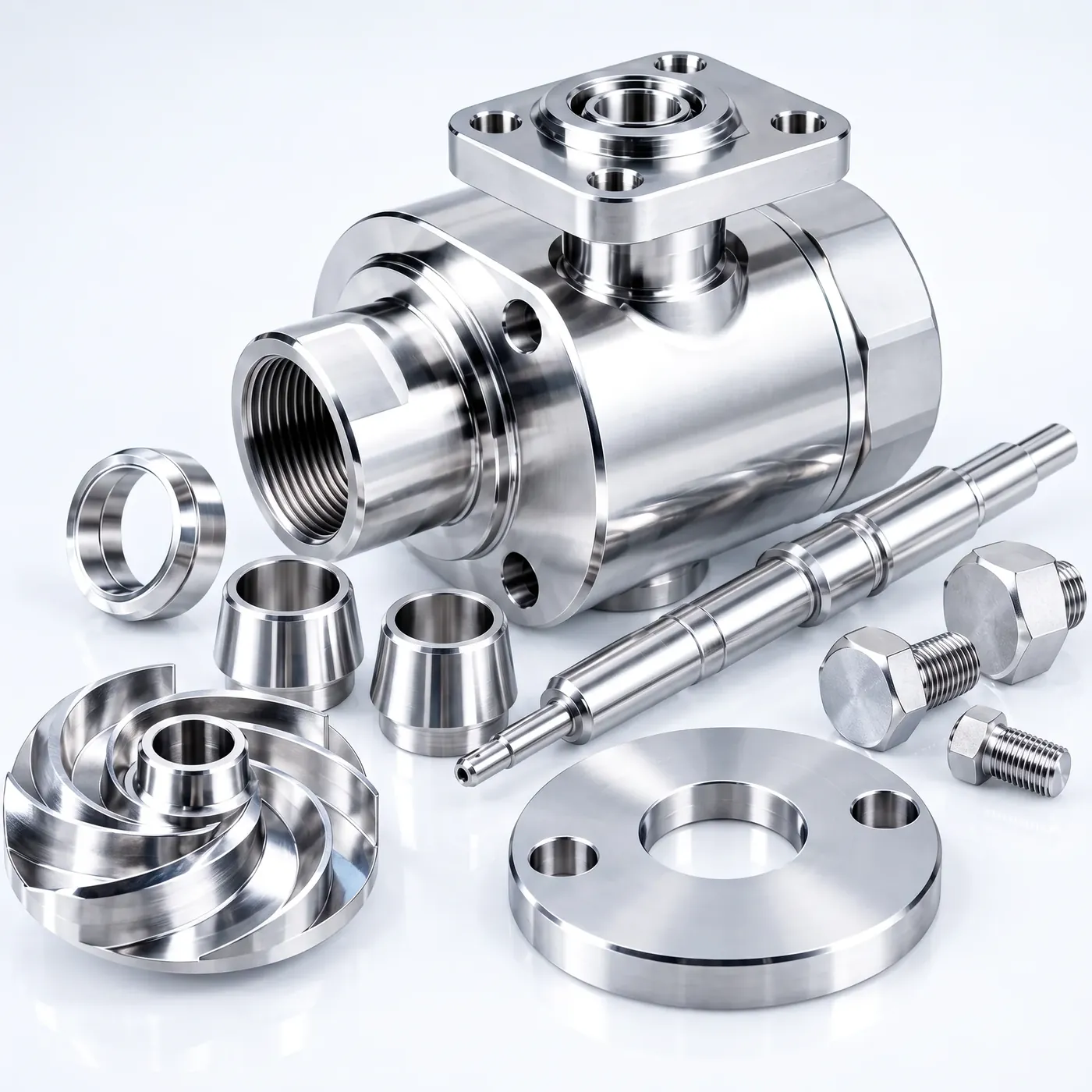
Coating-free alternative
The new coating-free alternative to tungsten carbide thermal spray coatings.
And to hard chrome plating, nickel plating, PVD/CVD coatings, boronizing, QPQ, MELONITE®/TUFFTRIDE® and Malcomizing. NEXT-Phase™ hardens the stainless itself, so there is no coating to chip, spall or corrode underneath.
NEXT-Phase™ versus tungsten carbideTungsten carbide thermal spray
HVOF WC-Co is typically 1050–1350 HV, sprayed 75–380 µm thick and ground to size. NEXT-Phase™ reaches comparable hardness with no layer to grind, no bond line to chip, and no line-of-sight limit in bores.
Hard chrome plating
No hexavalent chromium, no plating thickness to control and no microcrack network for corrosion to follow.
Nickel and electroless nickel
Nothing is deposited, so nothing can peel, blister or build up on edges and threads.
PVD and CVD coatings
Not line of sight and no adhesion interface. Bores, threads and internal passages harden along with the outside.
Boronizing
Boronizing runs at 700–1000 °C and ties chromium up in borides. We stay at or below 450 °C and keep it in solution.
QPQ
Salt-bath nitrocarburizing runs near 550–570 °C, where stainless forms chromium nitrides and loses its corrosion resistance.
MELONITE® and TUFFTRIDE®
The same salt-bath family. Hard, but at the cost of corrosion resistance on stainless. No molten salts are used in our process.
Malcomizing
Gas nitriding of stainless at roughly 495–565 °C (920–1050 °F), inside the chromium-nitride range. NEXT-Phase™ stays below it.
1000–1500HV0.05
Typical treated surface hardness, from a 200 HV base
≤ 450°C
Process temperature — below the chromium nitride precipitation window
10–50µm
Diffusion case depth. No coating, no interface to delaminate
±0growth
No measurable dimensional change. Tight-tolerance parts need no refinishing
The trade-off we remove
Stainless steel is specified for corrosion. It is rarely specified for wear.
Austenitic grades such as 304 and 316L are corrosion resistant because chromium in solid solution builds a passive oxide film. That same austenitic structure is soft — typically around 200 HV — it work-hardens rather than resisting wear, and it galls catastrophically when it slides against itself.
The conventional fixes both cost you something. Nitriding at 500–580 °C and carburizing at 850–950 °C precipitate chromium nitrides and carbides, pulling chromium out of solution and destroying the corrosion resistance you paid for. Hard coatings such as PVD, DLC and hard chrome introduce a mechanical interface that can chip, delaminate under load, and mask corrosion beneath it.
NEXT-Phase™ does neither. It is a diffusion treatment run cold enough that no chromium compounds can form.
What we actually create
Expanded austenite — the S-phase.
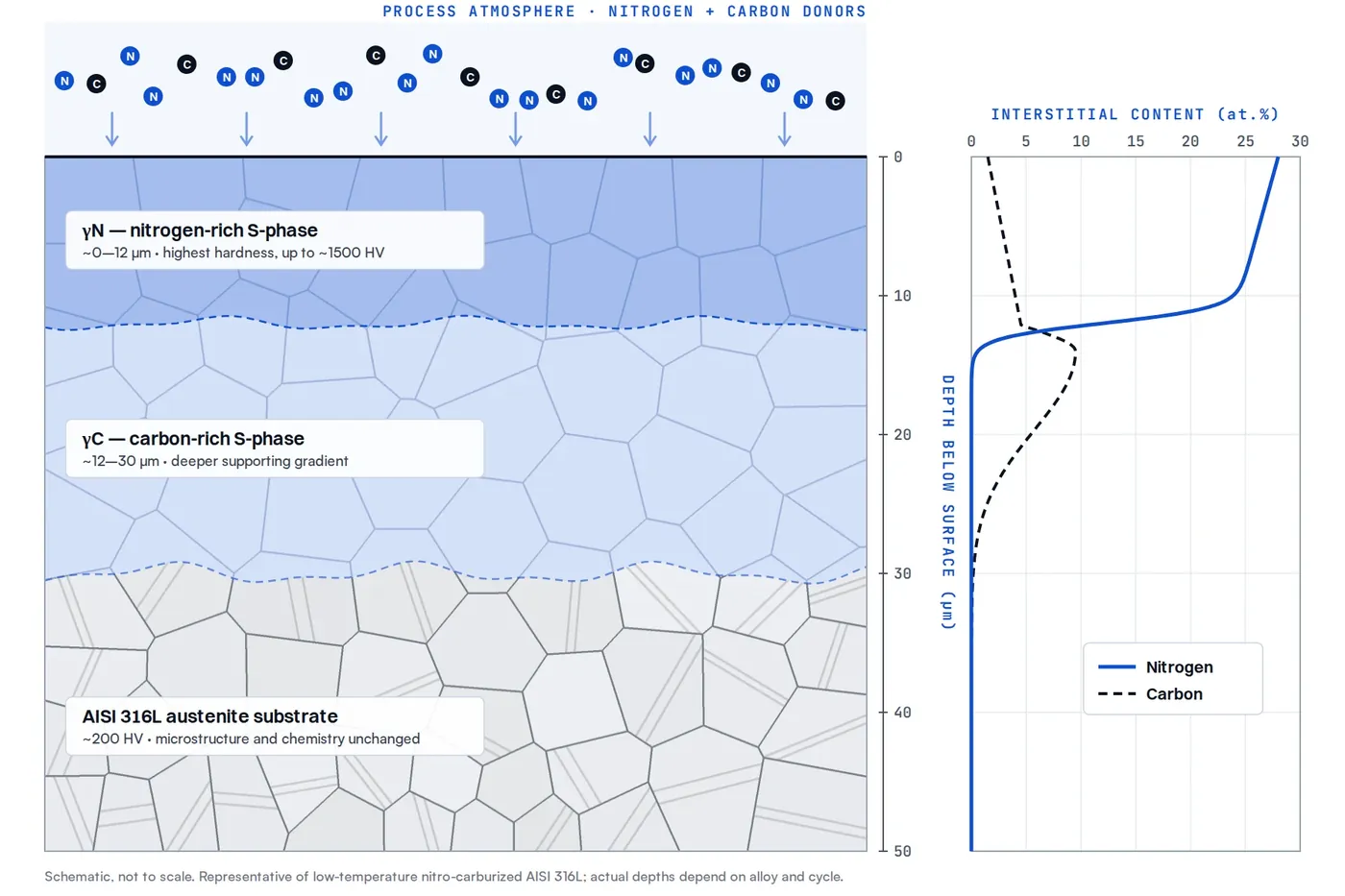
At low temperature, chromium is effectively immobile while carbon and nitrogen still diffuse freely. We exploit that gap: interstitial carbon and nitrogen are driven into the austenite lattice far past their equilibrium solubility — nitrogen contents near 28 at.% have been measured in treated 316L — and the lattice simply swells by a few percent to accommodate them.
The result is a supersaturated, precipitate-free single phase: expanded austenite, also called the S-phase. Hardness comes from extreme solid-solution strengthening combined with very high compressive residual stress. Chromium never leaves solution, so the passive film reforms exactly as before.
- Not a coating. The hardened zone is the original part, chemically modified. There is no interface, so nothing can flake, chip or delaminate.
- No brittle phases. The case is hard but ductile, and it deforms with the substrate instead of cracking off it.
- Colour and finish preserved. A polished part comes back polished. Ra is essentially unchanged.
Hardness profile
A hardness gradient, not a hard shell.
Hardness falls smoothly from the surface into the bulk, which is why the case carries load without spalling. Depth is set by time and temperature, so we tune it to the application: a thin case for a polished sealing face, a deeper case for rolling and sliding contact.
Micro-hardness against depth below surface
Representative profiles for low-temperature treated austenitic stainless steel, compiled from published data. Actual values depend on alloy and treatment time.
What you gain
Six properties change. One does not.
Surface hardness
From roughly 200 HV as-supplied to 1000–1500 HV0.05 at the surface. Abrasive and adhesive wear rates drop by orders of magnitude.
Galling and seizure
The classic stainless-on-stainless failure. A treated mating pair resists cold welding, so threaded joints, valve stems and sliding fits stop seizing.
Fatigue strength
High compressive residual stress in the case suppresses surface crack initiation, raising bending and rotating fatigue limits.
Corrosion resistance — unchanged
The one property that does not move. Chromium stays in solid solution, no sensitisation occurs, and in some conditions pitting resistance measurably improves.
Dimensional stability
Case growth is at the micron scale and the process runs far below any distortion or tempering threshold. Finished, tight-tolerance parts are treated as-is.
Cavitation and erosion
Pump impellers, nozzles and valve trim last longer where high-velocity fluid and entrained solids attack the surface.
Working with us
We prove it on your part before you release production.
Every alloy, surface condition and geometry behaves slightly differently. So we do not quote from a catalogue — we run your part, section it, and show you the data.
Start a sample trialTechnical review
Send drawings or samples with the alloy, heat treatment condition, surface finish and the failure mode you are seeing. We confirm suitability and recommend a process route.
Sample trial
We treat representative parts and return them with a metallurgical report: micro-hardness traverse, case depth measurement, cross-section metallography and dimensional check.
Production release
Once the route is fixed, parameters are locked to a written process specification so results are repeatable batch to batch.
Ongoing production
Batch traceability, retained process records and periodic verification coupons run alongside your parts.
Where it goes to work
Anywhere a corrosion-resistant alloy has to slide, seal or survive.
Food, beverage and pharma
Filling nozzles, mixer seals, conveyor components and clean-in-place hardware where lubricants are prohibited and washdown is aggressive.
02Semiconductor and UHV
Gas-handling fittings, ferrules and valve internals that must seal repeatedly without particle generation or galling.
03Energy, subsea and marine
Duplex and super-duplex fasteners, connectors and valve trim in chloride service where coatings fail at the interface.
04Pumps, valves and fluid power
Shafts, sleeves, seats, stems and impellers — sliding stainless against stainless, the application this process was made for.
05Medical and life science
Instruments, implant trials and fluid-path hardware in 316L and CCM alloys that must stay wear resistant through repeated autoclave cycles.
06Motion, tooling and automation
Linear guides, cams, grippers and forming tools in stainless where lubrication is limited and galling ends component life.